Here to enter, not to write about it? The rules, judging criteria and entry form are on the competition page. Free to enter, closes 15 November 2026.
Press and media / Research Question Prize
A free global essay prize asking students to explain a difficult question to a 12-year-old
Entrants explain a difficult academic question to a curious 12-year-old. $1,000 in cash across three places, and written comments returned on every entry submitted by 15 October 2026.
Everything on this page is free to use and quote, and every file is a direct download. Last updated 27 August 2026.
If you need one paragraph
The ScholarBridge Research Question Prize asks students aged 14 to 18, anywhere in the world, to take a difficult question in a subject they care about and explain it to a curious 12-year-old in no more than 1,000 words. Entry is free. First prize is $500. Anything submitted by 15 October 2026 is returned with written comments, and entries close on 15 November 2026. Details at scholarbridge.uk/scholarships/essay-prize/
Story angles
Depending on your audience, these are four aspects of the prize that may be useful. Each links to the policy or published page it rests on.
A competition that takes a position on AI
Entrants may use AI for spelling and grammar, must declare it in a note at the end of the essay, and are disqualified for AI-generated argument, structure or prose. Entries are read by people who read a lot of student writing. The policy is published in full rather than reduced to a checkbox, and the declaration is part of the entry itself.
The generative AI policy →Everyone who enters early gets something back
Many student competitions return a result but no individual feedback. Every entry submitted by 15 October 2026 comes back with written comments from the judging panel, whether or not it places, and every valid entry receives a certificate. For the large majority who will not win, that feedback is the point of entering.
How entries are judged →Explaining something clearly is a harder test of understanding
Technical vocabulary hides gaps in understanding. Explaining the same idea to a curious 12-year-old does not. Teachers have used the prompt as a classroom exercise without anyone entering, which is a use we actively encourage; there is a paragraph on the competition page written to be pasted into a bulletin.
The prompt and the criteria →A student journal that will never charge authors
Winning and commended essays go into the first volume of The ScholarBridge Review in early 2027. Some student publications charge submission, processing or publication fees. The Review charges none of them, acceptance cannot be bought, and it is free to read.
The ScholarBridge Review →Key facts
Every line restates something published on the competition page. Where the two ever disagree, the competition page governs.
| What | The ScholarBridge Research Question Prize, an international essay competition |
|---|---|
| Who can enter | Students aged 14 to 18 at the closing date, in any country, any school system, any subject |
| Entry fee | None. No account, no purchase, and no connection to ScholarBridge required |
| The task | Take a difficult question in a subject you care about and explain it to a curious 12-year-old |
| Length | 1,000 words maximum, in English |
| Feedback | Every entry submitted by 15 October 2026 is returned with written comments, whether or not it places |
| Closes | 15 November 2026 |
| Results | All entrants notified by 10 December 2026 |
| Cash prizes | $500 first, $300 second, $200 third. Unconditional, and paid to a parent or guardian where the winner is under 18 |
| Scholarships | Winners also receive a scholarship toward a ScholarBridge programme, which never covers a programme in full |
| Every entrant | A certificate of entry naming the competition and the round |
| Judging | Read blind against four published criteria by a panel drawn from ScholarBridge academic staff and mentors, including a DPhil historian at Merton College, Oxford, doctoral researchers at NYU, and a researcher at a Harvard Medical School teaching hospital. Affiliations describe individual academic positions and do not imply institutional endorsement. A judge with any connection to an entrant does not read that entry |
| Under 18s | A parent or guardian is named on the form and contacted only if the entry places |
| Publication | Winning and commended essays are published only with the entrant's consent, and a parent or guardian's where the entrant is under 18. Copyright remains with the entrant |
| AI | Permitted for spelling and grammar only, and must be declared. Generated argument or prose is disqualifying |
Press release
Free to reproduce in whole or in part, with or without attribution. Select and copy; there is no PDF to download.
27 August 2026
ScholarBridge launches free global essay prize asking students to explain a difficult question to a 12-year-old
Entrants are asked to explain a difficult academic question to a curious 12-year-old. $1,000 in cash across three places, and written feedback for every entry submitted by 15 October 2026.
ScholarBridge has opened entries for the Research Question Prize, a free international essay competition for students aged 14 to 18 in any country and any school system.
The task is deliberately narrow. Entrants take a difficult question in a subject they care about and explain it to a curious 12-year-old in no more than 1,000 words, making clear what the question is really asking, why the answer is not obvious, and what remains uncertain or unresolved.
"A student can hide behind technical vocabulary surprisingly easily," said David Kors, founder of ScholarBridge. "Explaining the same question to a bright 12-year-old removes the hiding place. We wanted a competition that rewards understanding rather than sounding impressive."
Every entry submitted by 15 October 2026 is returned with written comments from the judging panel, whether or not it places. Entrants in most essay competitions hear nothing beyond a result.
Entries are read blind against four published criteria by ScholarBridge academic staff and mentors, and a judge with any connection to an entrant does not read that entry. First place receives $500 in cash, second $300 and third $200, paid whether or not the winner has any further contact with ScholarBridge, and paid to a parent or guardian where the winner is under 18. Winners also receive a scholarship toward a ScholarBridge programme, which never covers a programme in full. Every valid entry receives a certificate.
Entry is free, requires no account, and carries no expectation that entrants become ScholarBridge students. Entries close on 15 November 2026 and every entrant is notified by 10 December 2026, before most schools break up for December.
Winning and commended essays are published with the entrant's consent, and a parent or guardian's where the entrant is under 18, on the ScholarBridge site and in the first volume of The ScholarBridge Review, a free journal of pre-university research due in early 2027. Copyright remains with the entrant throughout.
Full details, judging criteria and the entry form are at scholarbridge.uk/scholarships/essay-prize/
Images and logos
Free to use in coverage of the prize or of ScholarBridge. No credit required, though "ScholarBridge" is appreciated.
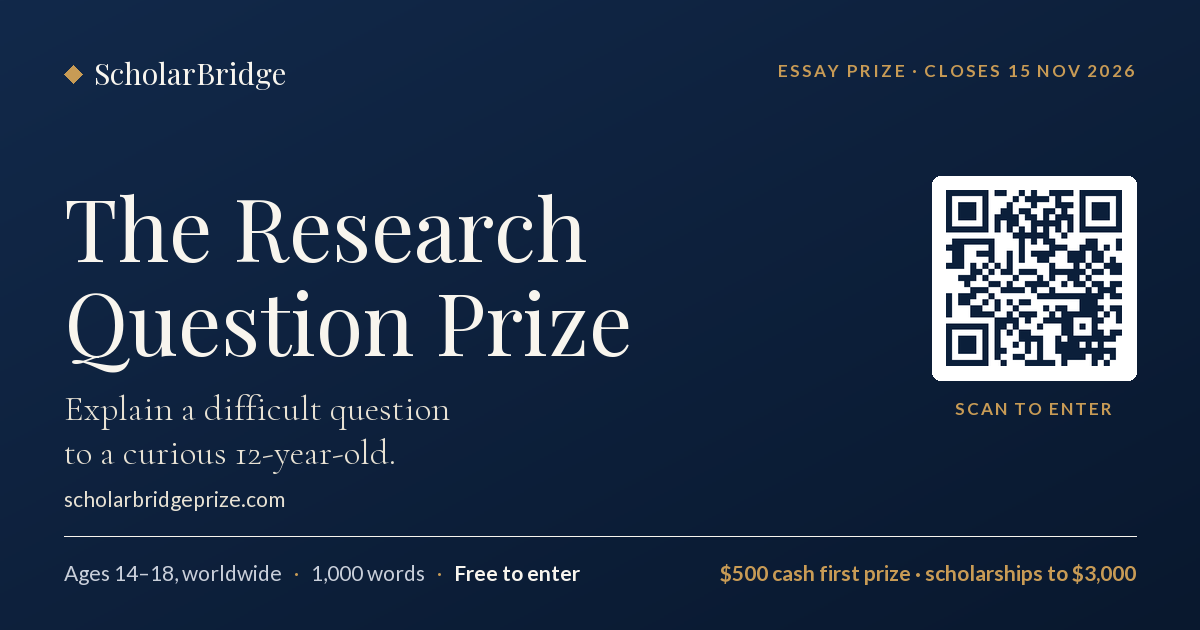




If your layout needs a different crop or a print-resolution file, email [email protected] and we will send it the same day.
Press contact
David Kors
Founder, ScholarBridge
Happy to answer questions on the record, provide the judging criteria in either edition, or arrange an interview. We will say plainly when we do not know something.
ScholarBridge boilerplate in three lengths, the full brand asset set with usage rules, and the datasets we maintain for citation are all in the newsroom.
For fact-checking
The rules, criteria, prize terms and dates are published in full on the competition page, and the policies that govern it are public: the generative AI policy, the safeguarding policy, the privacy policy, the terms, and our editorial standards.
If you are writing about essay competitions more broadly, our directory of UK essay competitions is maintained and every entry carries the date it was last checked against the organiser's own page. Use it, cite it, or crib from it; that is what it is for.