November 2026 round · Free to enter
The Research Question Prize
Take a difficult question in a subject you care about and explain it to a curious 12-year-old, in no more than 1,000 words. Free to enter, judged blind, $500 first prize.
The prompt
November 2026 prompt
Choose a difficult question in an academic subject you care about. In no more than 1,000 words, explain it to a curious 12-year-old.
Help them understand what the question is really asking, why the answer is not obvious, the most important ideas or disagreements involved, and what remains uncertain or unanswered.
We are not looking for the most complicated topic. We are looking for clear thinking about a genuinely difficult question.
Any subject. The question can come from a textbook, a news article, a paper, a class debate, or your own head.
Explaining something clearly is a good test of whether you understand it. Technical language can hide a gap in your thinking; explaining the same idea to a 12-year-old cannot. If you skip a step or use a word you cannot explain, the reader notices immediately.
The strongest entries will go beyond explaining the question itself. They will show where the real difficulty lies: what remains uncertain, where reasonable interpretations differ, or what evidence is still missing.
Not sure which question to pick?
Start with one you have actually run into: a lesson that stopped before the interesting part, a book, a problem you could not solve. A good sign is that there seems to be an easy answer at first, but it becomes more complicated when you look closely. Famous unsolved problems are allowed. So is a question most 12-year-olds have never heard of, explained by someone who cares about it.
The kind of question we mean: why can we forecast the weather a week ahead but not a month? Did the printing press cause the Reformation? Why is it so hard to prove that a new medicine works?
Prizes
First
$500 cash
+ 50% scholarship, up to $3,000
$500 in cash, paid whether or not the winner enrols in anything. Plus a scholarship of half the fee for the ScholarBridge programme the winner chooses, up to $3,000. One awarded per round.
Second
$300 cash
+ 35% scholarship, up to $2,000
$300 in cash, unconditional, plus a scholarship of thirty-five percent of the programme fee, up to $2,000. One awarded per round.
Third
$200 cash
+ 20% scholarship, up to $1,000
$200 in cash, unconditional, plus a scholarship of twenty percent of the programme fee, up to $1,000. One awarded per round.
Highly Commended
Certificate
no fixed number
A Highly Commended certificate for entries of genuine quality that do not place. The number depends on the strength of the round, not on a quota, and commended entries are published alongside the winners, on this site and in The ScholarBridge Review, with the entrant’s consent.
Places are awarded on merit, not to fill a quota: if no entry in a round meets the standard for a place, that place is not awarded. The cash prize and the scholarship are separate things. The cash is paid within 30 days of the results, by bank transfer, to a parent or guardian where the winner is under 18, and it does not depend on enrolling in anything. The scholarship is a share of the fee, never the whole of it, so a place always remains partly funded by the family: the dollar figure is a ceiling on that share, and whichever is lower, the percentage or the ceiling, is what applies. Scholarships reduce the ScholarBridge programme fee only, are valid for twelve months, carry no cash value themselves, cannot be transferred, and do not oblige the winner to enrol. Programme fees are confirmed at consultation.
What every entrant gets, placed or not
- A certificate for every valid entry, and written comments from a mentor on anything submitted by 15 October 2026. The comments are on the thinking, not the presentation: whether the question was genuinely difficult, and whether the explanation held up.
- Practice at the thing admissions actually tests. Explaining a hard question clearly is the skill behind the first UCAS personal statement question, the Common App essay, the IB Extended Essay, and every Oxbridge interview. The essay is 1,000 words, so it is a realistic thing to attempt alongside A-levels, the IB Diploma, or AP coursework.
- A route into The ScholarBridge Review, a selective edited journal of pre-university research. There are no author fees, and the online Review is free to read. Volume 1 appears in early 2027.
The prize is run by ScholarBridge, which pairs students aged 14 to 18 with doctoral-level mentors for one-to-one research projects, for applications through both UCAS and the Common App. Entering the prize is free, requires no account, and carries no obligation to consider a programme. Merit scholarships covering 10 to 100 percent of a programme fee are awarded separately, on the strength of the application.
How entries are judged
Is the question genuinely difficult, and does the entry show why?
We are not scoring how impressive the topic sounds. A strong entry makes clear what the question is really asking, why a simple answer is not enough, and where the difficulty actually lies.
Would a curious 12-year-old follow it?
Every technical word is explained or left out. Use a concrete example when an abstract explanation would lose the reader. Do not talk down to them either. A 12-year-old can tell when they are being patronised.
Does it handle the complexity honestly?
Explain the main ideas, interpretations or disagreements fairly. Be clear about what remains uncertain, contested or unanswered. If experts disagree, explain why. If evidence is missing, say what is missing. Do not manufacture a neat two-sided debate where one does not exist.
Is the thinking the entrant's own?
We would rather read an uneven essay that is clearly a real person working something out than a polished one that could have been written about any subject by anyone.
Polish is not a criterion. We do not reward ornate vocabulary, formality, or a long bibliography for their own sake. Clarity matters because the prompt asks for it. A clear entry in plain language beats an impressive-sounding one that does not explain the question.
Entries are read blind by a panel drawn from our academic staff and mentors, including our DPhil historian at Merton College, Oxford, and doctoral researchers at NYU and a Harvard Medical School teaching hospital. Where a judge has any connection to an entrant, that judge does not read the entry.
Rules and dates
- Round
- November 2026
- Opens
- 15 August 2026
- Feedback by
- 15 October 2026. Entries in by this date are returned with written comments.
- Closes
- 15 November 2026
- Results
- by 10 December 2026
- Length
- 1,000 words maximum, excluding references
- Language
- English
- Eligibility
- Aged 14 to 18 at the closing date, any country
- Entry fee
- None
- One entry per student per round, and one student per entry: joint entries are not accepted. The work must be the entrant's own and must not have been submitted for assessment elsewhere.
- Entrants under 18 give a parent or guardian's name and email on the entry form. We contact them only if the entry places: consent is confirmed with them before anything is published, and any cash prize is paid to them. We do not collect personal data beyond what is needed to judge and to reply.
- AI use is limited to spelling and grammar and must be declared in a short note at the end of the essay. The note does not count toward the word limit. See the generative AI policy.
- Sources must be cited where used. A simple list at the end is fine and does not count toward the word limit. Fabricated citations are treated as disqualifying rather than as a referencing error.
- Copyright remains with the entrant, always. Publication happens only if your entry places, and only with your confirmation at that point, and a parent or guardian's where you are under 18. That confirmation grants ScholarBridge a non-exclusive licence to publish the entry on this site and in The ScholarBridge Review, online and in the Review's print editions and anthologies; to quote short excerpts, with attribution, to present the Review and its authors; and to permit republication by school and student publications, with attribution and a link. Consent can be withdrawn at any time: the work comes off this site and the online Review and out of any future printing, though copies already printed cannot be recalled.
- Our safeguarding policy applies to all contact with entrants.
Frequently asked questions
Who can enter?
Students aged 14 to 18 at the closing date, in any country, in any school system, studying any subject. Entrants do not need to be ScholarBridge applicants and there is no expectation that they become one.
Is there an entry fee?
No. Entry is free and always will be. A competition that charges students to enter and then awards them a discount on the organiser's own product is a sales funnel, not a prize.
Can I use AI to write my entry?
You may use AI to check spelling and grammar, and you must say so in a short note at the end of your essay. The note does not count toward the word limit. You may not use it to generate the argument, the structure, or the prose. Entries are read by people who read a great deal of student writing, and an entry we believe to be AI-generated is disqualified without appeal. Our full position is set out in the generative AI policy.
What happens to my essay?
Winning and commended entries are published on this site and in The ScholarBridge Review, our free journal of pre-university research, with the entrant's consent, and a parent or guardian's where the entrant is under 18, credited by first name, year group, and country unless the entrant asks otherwise. Entries that do not place are not published, not shared, and not used for any other purpose. Copyright stays with the entrant throughout.
Is there a cash prize?
Yes. First place receives $500, second $300, and third $200, in addition to the programme scholarships. The cash is unconditional: it is paid whether or not the winner has any further contact with ScholarBridge, within 30 days of the results, by bank transfer, and to a parent or guardian where the winner is under 18.
Do entrants receive anything for taking part?
Yes. Every valid entry receives a certificate of entry naming the competition and the round, commended entries receive a Highly Commended certificate, and winners receive a winner's certificate alongside the prize. Certificates state what was actually judged, so the line a student writes on an application stands up to being asked about.
Does the scholarship cover the whole programme?
No, and that is deliberate. Each award covers a share of the fee, up to half of it for first place, and the family pays the remainder. We would rather fund a larger number of students partway than fund one student entirely, and a place that is partly paid for tends to be taken more seriously by everyone involved.
Do I have to accept the scholarship if I win?
No. There is no obligation to enrol, and declining the scholarship does not affect the prize itself. If a winner does enrol, the award reduces the programme fee and the usual consultation happens as it would for anyone.
Will my parent or guardian be contacted?
Only if your entry places. Entrants under 18 give a parent or guardian's contact on the form so that, if the entry wins or is Highly Commended, we can confirm consent with them before anything is published and pay any cash prize to them. Entries are judged without waiting for anything from home.
How are entries judged?
Against the four published criteria, by ScholarBridge academic staff and mentors. Entries are read with names removed. Where a judge has any connection to an entrant, that judge does not read the entry.
Do I have to write like a children's book?
No. The 12-year-old is a standard for clarity, not a style. Write the way you would explain it to a bright younger sibling who keeps asking why: plain words, concrete examples, nothing assumed. Make the explanation simpler. Leave the question as hard as it is.
Can I choose a famous unsolved problem?
Yes, but it is not an advantage. Dark matter and a question from last week's history lesson are judged on the same four criteria, and a smaller question you actually understand usually beats a large one you do not.
What is the feedback deadline?
Anything submitted by 15 October 2026 is read and returned with written comments: whether the question was a good choice, where the explanation is clear, where it loses the reader, and whether you have identified the remaining uncertainty clearly and accurately. It is the same competition and the same judging, not a separate round. Entries after that date are judged as normal but we cannot promise comments on all of them.
When do I hear back?
All entrants are notified by 10 December 2026, whether or not they have placed. Results land before most schools break up in December, so a student can put the outcome on an application in the same academic year.
What if I cannot enter before 15 November 2026?
The next round is the March 2027 round. Its question is announced on 15 December 2026, entries open on 15 January 2027, the feedback deadline is 15 February 2027, entries close on 15 March 2027, and results follow by 10 April 2027. Eligibility and prizes carry over unless the rules on this page say otherwise when that round opens.
How to enter
Upload your entry as a PDF or Word document. It takes about two minutes and asks for your age, year group, country, school and subject. Adding your counselor's email is optional.
Do not put your name in the document itself. Your details go in the form, the essay stays anonymous, and judges read it without knowing who wrote it.
If you are under 18 the form asks for a parent or guardian's name and email; they are contacted only if your entry places. No school permission is needed. If your school network blocks the form, email [email protected] instead and we will take it that way.
Nothing showing above? Open the form directly at tally.so/r/RGQZ0J, or send your entry to [email protected].
Not entering today?
Take the question pack with you
We will email you the judging criteria one-pager, then two reminders and nothing else: one before the 15 October 2026 feedback deadline, one before entries close on 15 November 2026. Useful for a student still choosing a question, or a teacher passing it on.
For teachers and counsellors
If you work with students in the sixth form, IB diploma or high school years, this is a free competition you can point them at without it costing them or the school anything. There is no entry fee, no account to create, and no requirement to be considering a ScholarBridge programme. Entries are read with names removed.
It is a useful exercise even for students who do not enter. Explaining a difficult question to a younger reader quickly shows what a student understands and where their reasoning still has gaps. The same skill carries directly into research proposals, EPQs and university interviews.
Text for a newsletter or bulletin
The ScholarBridge Research Question Prize is open to students aged 14 to 18 in any country. Entrants choose a difficult question in a subject they care about and explain it to a curious 12-year-old in no more than 1,000 words: what the question is really asking, why the answer is not obvious, the most important ideas or disagreements, and what remains uncertain or unanswered. First prize is $500 in cash plus a programme scholarship, every valid entry receives a certificate, and entries are judged blind against published criteria. Entry is free and closes on 15 November 2026. Anything submitted by 15 October 2026 is returned with written comments. Details and the entry form: scholarbridgeprize.com
Graphic for a newsletter or noticeboard
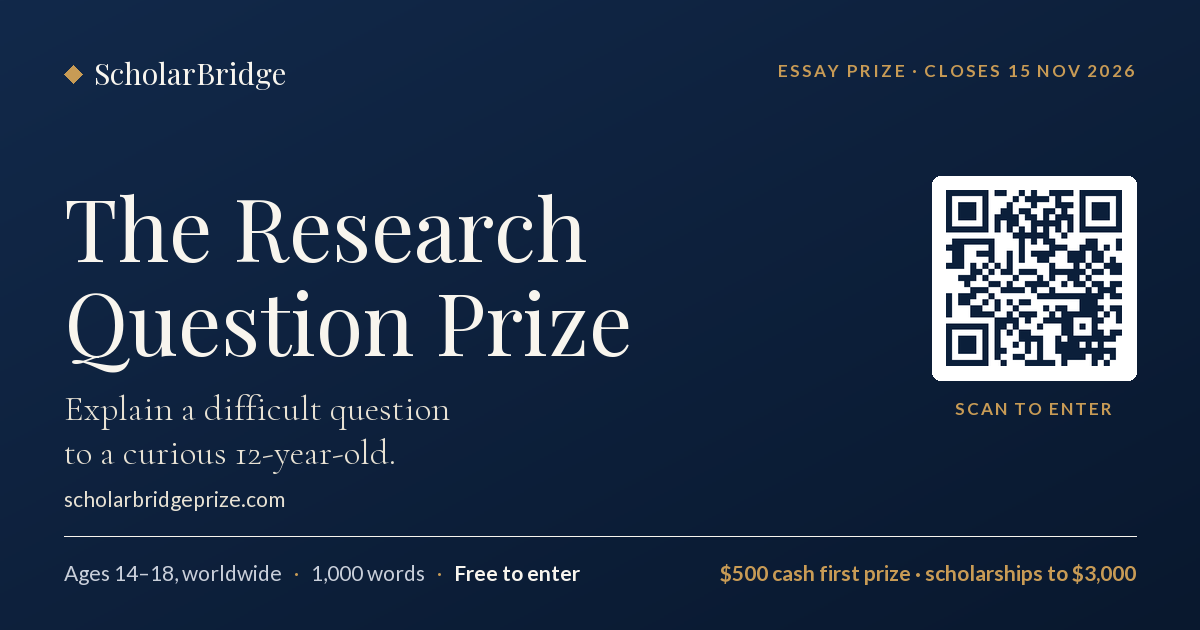
Free to reproduce in a school newsletter, bulletin or noticeboard. Download the image.
- Entry is free and open to any student aged 14 to 18, anywhere, with no connection to us required.
- Every student who submits a valid entry receives a certificate of entry, commended entries receive a Highly Commended certificate, and winners receive a cash prize and a winner's certificate. That gives every entrant something honest to cite on an application: a named, judged, international essay competition they took part in.
- Students enter directly and no school permission is needed. For entrants under 18, the parent or guardian named on the form is contacted only if the entry places.
- If it would help to talk it through first, or you would like the prompt as a classroom exercise, write to [email protected].
- Writing about the prize? Story angles, key facts, a press release and images are in the press materials, none of it gated.